
This is a question many of our clients ask when we first reach out to them. So here's the clearest possible answer. Search engine optimization is the process of optimizing your information to show up on search engines. Local search engine optimization is the process of optimizing your business to show up in localized searches, like "Las Vegas locksmith" or "mobile mechanic Murrieta" or "bail bonds Riverside."
With the right resources, you can quickly get new business through these local searches. Those resources are directory citations, website optimization, content marketing, and your Google Business Profile. Most important is the optimization of your Google Business Profile. This is the area of your online presence that is most likely to be seen first for most localized business searches.
The Three Pillars of Local SEO
1. Google Business Profile (GBP)
Formerly Google My Business. This is the listing that shows up in the map pack at the top of local search results. It's the 3 pack of business listings with the little map. GBP optimization is roughly half the local SEO game and most businesses treat it as an afterthought. Don't.
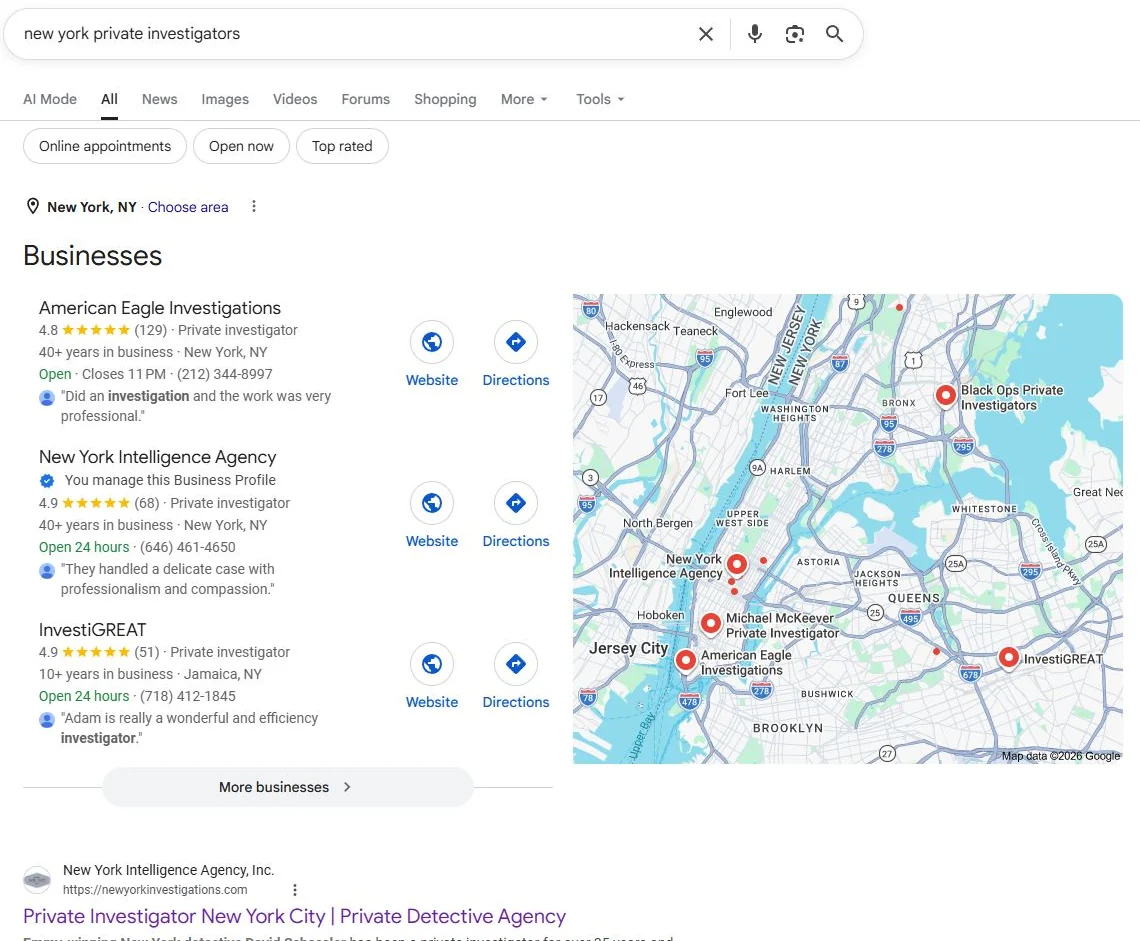
2. Local Organic Search
The website results that appear below the map pack, ranked for local intent queries. This is where on site SEO, content marketing, internal linking architecture, and technical SEO live. For service business sites with real depth, this can be where 40 to 50% of traffic comes from.
3. Citations & Reviews
This is your business's presence across the broader local web, like Yelp, BBB, and industry directories. It also covers the review signals that flow back to Google. Reviews directly impact map pack rankings. Citation consistency directly impacts trust signals.
Win all three simultaneously and your competition will struggle to catch up. Win only one and you'll plateau.
How to Start Your Local SEO Campaign
Step one should be to optimize your Google Business Profile. If you haven't claimed your page yet, start by heading to google.com/business. Once there, you'll be able to locate or claim the existing page for your business.
Make sure you cover these steps when you optimize your GBP.
- Business name. Use it exactly as it appears on your storefront, with no keyword stuffing.
- Business hours. Include holiday hours and special hours.
- Phone number. Ideally, use a tracking number for attribution.
- Website link. Use your primary domain.
- Business description. Use the 750 characters, write naturally, and include your primary service and city.
- Photos of your business. At minimum, add a logo, a cover, 10 interior, 10 exterior, 5 team, and 10 of your work.
- Use Google Business Profile posts. Post weekly at minimum (see our posts guide).
- Join relevant Google product categories. Pick your primary and 5 to 9 secondary categories carefully.
- Encourage customers to leave reviews. Never offer incentives, but always ask.
- Respond to every review. Answer positive and negative ones within 24 hours.
- Place new content into your page often. Add products, services, photos, and posts.

Working with these steps will show you an immediate impact in the Insights tab on your business page. Growing your local search campaign from there relies heavily on directory citations. That means the consistency and breadth of your business's presence across the broader web.
Why Search Engines Care About Your Directory Listings
Search engines don't just look at your profile on their platform. They also index how your business shows up elsewhere on the web. Think about it. What makes Google more successful than any other search engine is their ability to show accurate results to a user's search quickly. Inaccuracies about your business make you a less desirable option to show to search traffic.
Run a directory scan and look at how your business shows up. Make sure your listings have all the same details we covered in setting up your GBP. That means the same name, address, phone, and hours. For the full list of where to start, see our top ten free listings guide. For the managed alternative, see our Does Yext Work? breakdown.
Optimizing Your Website for Local Search
Domain Strategy
When choosing a domain name for your business, a classic move for showing relevance to a local market is picking a geo targeted domain name. LongBeachLandscaping.net is one example. When doing a search in Google for "Long Beach landscaping" or "Long Beach lawn care," you'll notice that geo targeted domains often have an edge in both the local listings and the organic results below.
That said, this strategy is less powerful in 2026 than it was in 2017. Google's algorithm has gotten better at understanding semantic relevance, so a well named brand that ranks well in local can compete with exact match domains. But for a brand new business with no authority yet, the geo targeted domain is still a useful boost.
Don't Fire and Forget
Your website should not be fire and forget. When you post new content and photos about your business on your website, search engines index this and place value on the right kind of content. The more you post relevant content, the more traffic you'll receive.
Meta descriptions and other on site optimization are important, but above all else, putting out new quality content is the number one thing search engines want to see from your business. While developing new content can be difficult, the return on the investment of your time will do more for your business growth online than almost any other single area.
Technical SEO Foundation
If you're on WordPress, install Yoast SEO and set up your XML sitemap. We have a full walkthrough at how to create and submit a sitemap in WordPress. The sitemap gets submitted to Google Search Console, Bing Webmaster Tools, Yandex, and Baidu. The indexing speed gain is significant for new sites.
Do Social Profiles Matter For Local Marketing?
Yes, but maybe not in the way you'd expect. By listing your social profiles on directories that accept them and having links to them on your website, search engines start to index and read your social signals.
Simply having a profile on sites like Facebook and Twitter (now X) isn't enough. Make sure to maintain healthy posting regimens of the same valuable content you're preparing for your website and directory citations. The more you work for your business, the better your business will work online for you.
How Long Does Local SEO Take?
Honestly, it takes 3 to 6 months for measurable movement and 9 to 12 months for sustained top 3 rankings in competitive markets. Anyone promising you "page one in 30 days" for a competitive local term is either lying or planning to use black hat tactics that will eventually get you penalized.
Our money back guarantee is rank on the first page of Google in 90 days or a full refund. We deliver on that because the framework we use is the same framework we use to rank our own brands. See our strategy guide for the full breakdown, or our how to choose the best local SEO company guide if you're vetting agencies.
One Last Thing
Local SEO isn't a one time setup. It's an operating system for how your business shows up online. The businesses that win in local search are the ones whose owners (or agency partners) treat it as ongoing operations, not a project you finish.
If you want to do this yourself, the guides on this blog are the playbook we use. If you'd rather hire us to do it for you, reach out. We'll be straight with you about whether we're a fit.


