
AEO stands for answer engine optimization. It is the work of making your business the one that AI tools name, quote and link when someone asks a question. The answer engines are Google's AI Overviews and AI Mode, ChatGPT, Gemini, Perplexity, Copilot and voice assistants like Siri. AEO does not replace SEO. It is built on top of it.
People used to type "mechanic near me" and scroll a list of links. Now a lot of them ask ChatGPT "who is a good mechanic in Hemet that does mobile repair" and get three names back. Being one of those names is what AEO is about. This guide covers what AEO is, how answer engines pick what to say, how it differs from SEO and GEO, and what it means for a local business. It also shows what we are seeing in our own analytics as AI starts sending real visitors to the sites we build.
Most guides on this topic are written for software brands and big publishers. This one is written for the plumber, the locksmith, the bail bondsman and the auto shop. That is who we build for, and it is where the advice changes the most.
What Is AEO?
Answer engine optimization is the practice of shaping your website, your listings and your reputation so that AI tools give your business as an answer. A search engine gives you ten links and lets you choose. An answer engine reads those links for you and hands back a short reply. Sometimes it cites its sources. Sometimes it names a business outright.
The goal of classic SEO is to rank. The goal of AEO is to be the answer, or at least to be one of the sources the answer is built from. In practice the two overlap a lot, and we will get to exactly where they split.
What AEO Stands For, and the Other AEOs You Will See
In marketing, AEO means answer engine optimization. If you search the term you will also see Authorized Economic Operator, a customs status for shippers, and American Eagle Outfitters, whose stock ticker is AEO. Neither has anything to do with search. When an agency says AEO, they mean getting found in AI answers.
Which Answer Engines Matter in 2026
- Google AI Overviews. The AI summary that now sits on top of many Google results. It is the answer engine most of your customers already see every day, whether they asked for it or not.
- Google AI Mode. A separate tab in Google Search that works like a chat. It is showing up next to "All" and "Images" on local searches too, including the New York search in the screenshot further down this page.
- ChatGPT. The biggest standalone answer engine. Its search feature crawls the web with its own bot and returns cited links.
- Gemini. Google's assistant, on phones and in the Gemini app.
- Perplexity. A research style answer engine that cites every claim.
- Microsoft Copilot. Built into Windows, Edge and Bing, and it draws on Bing's index.
- Siri. Apple's voice answers for local businesses lean on Apple Maps data.
How Answer Engines Decide What to Say
You do not need to know how a language model works to do AEO well. You do need to know the three steps every answer engine takes before it replies.
Step One Is Retrieval From a Search Index
When someone asks a question about the real world, like a business, a price or a place, the answer engine searches first. Google's AI features pull from Google's own index. ChatGPT runs its own crawler, called OAI-SearchBot, and also works with search partners, including Bing. Copilot is built on Bing. Google's own guidance on AI features says the same things that help a page show up in Search help it show up in AI Overviews and AI Mode.
That is the single most important fact in AEO. If you are not in the index, you cannot be in the answer. Everything else comes after that.
Step Two Is Consensus
Once an engine has a pile of pages, it looks for agreement. If your website, your Google Business Profile, your Yelp page, three directories and a Reddit thread all say you are the mobile mechanic in Hemet who does diagnostics on site, the engine can say that with confidence. If your site says one thing and your listings say another, you look like a risk, and engines avoid risk.
This is why reviews, directories and forum mentions matter so much more in AEO than they did in classic SEO. They are the other voices in the room.
Step Three Is Extraction
Last, the engine lifts short, clear pieces of text to build its reply. A sentence like "We charge $225 for a standard pre purchase inspection" is easy to quote. A paragraph of marketing fluff is not. Pages that state facts plainly, in the words a customer would use, get quoted. Pages that hide the answer do not.
AEO vs SEO vs GEO
These three terms get used like they are rivals. They are not. They are layers of the same job.
| SEO | AEO | GEO | |
|---|---|---|---|
| Stands for | Search engine optimization | Answer engine optimization | Generative engine optimization |
| The goal | Rank in the list of results | Be the answer or a cited source | Be named inside AI written replies |
| Where it shows | Google and Bing results, the map pack | AI Overviews, featured snippets, voice, chat answers | ChatGPT, Gemini, Perplexity, Copilot replies |
| What wins | Relevance, links, technical health | Clear answers, structure, consensus | Mentions, reviews, clear facts across the web |
| How you measure it | Rankings, clicks, calls | Citations, AI referral visits, calls | Brand mentions, AI referral visits, calls |
Is AEO Replacing SEO?
No. Every answer engine that talks about the real world searches an index first, and SEO is how you get into the index and rank well inside it. What is changing is how many people click. Pew Research found that Google users who saw an AI summary clicked a traditional result in only 8% of visits, and they were less likely to click than users who saw no summary. So the visits that do come through matter more, and being named in the summary itself matters a lot.
AEO vs GEO vs AIO
GEO means generative engine optimization. AIO is sometimes used for AI optimization. In the real world, agencies use AEO, GEO and AIO for the same shift. If you want to split hairs, AEO grew out of featured snippets and voice answers, and GEO is about the chat style engines. The work to win them is almost the same, so we use AEO for all of it.
Why AEO Matters for Local Businesses
Almost every AEO guide on the first page of Google is written for software companies and national brands. Local businesses have a different problem and a bigger opportunity.
What Happens When Someone Asks AI for a Local Business
Ask ChatGPT "who is a good locksmith in Las Vegas" or ask Google's AI Mode "best private investigator in Manhattan" and you get a short list of names, often with a line on why each one was picked. Those lines come from somewhere. Usually it is the business's own site, its Google Business Profile, its reviews and a handful of directories and articles. A business with a thin site, a half finished profile and 11 reviews has nothing for the engine to work with.
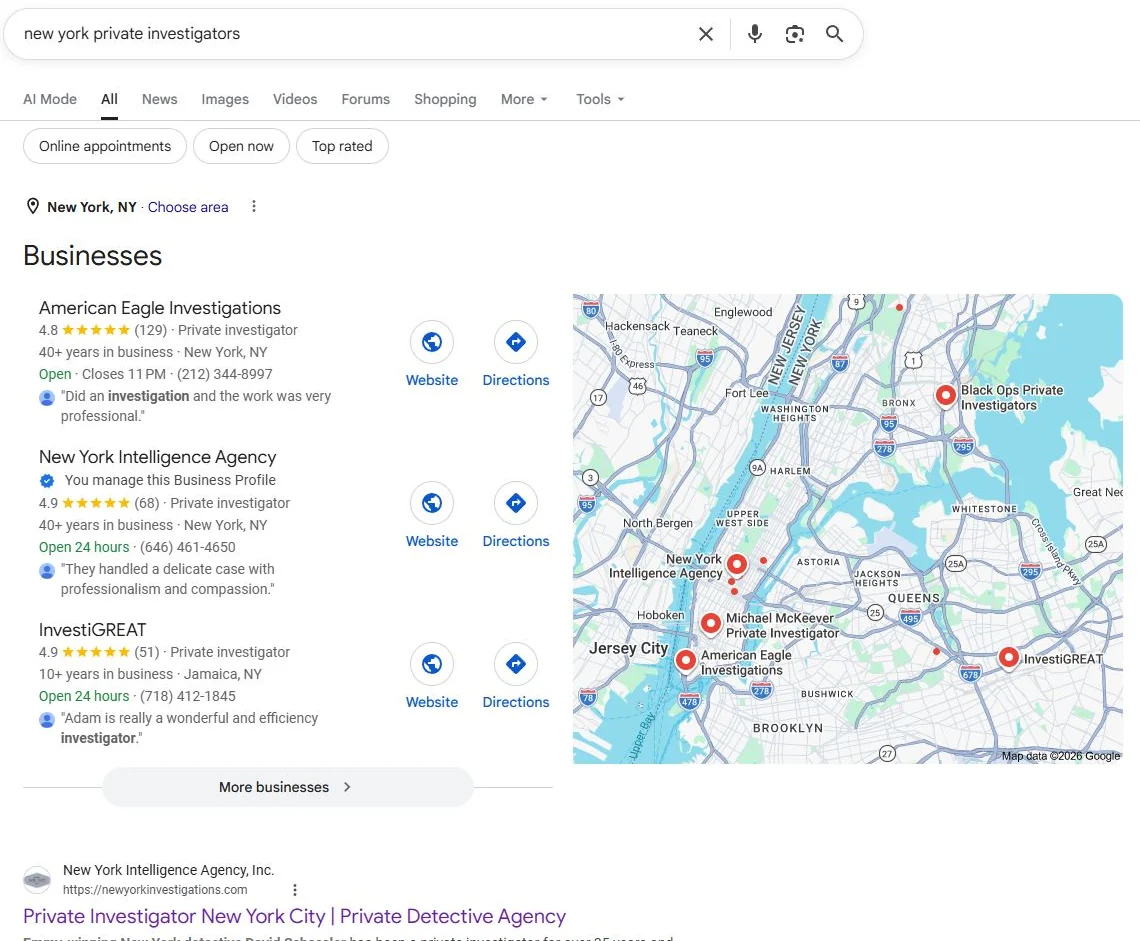
The Map Pack and AI Answers Feed Each Other
For local searches, Google's AI answers lean on Google Business Profile data. Your categories, services, hours, photos and reviews all show up in how the AI describes you. That is good news. It means the work that wins the map pack also feeds the AI answer. A local business does not need two separate strategies. It needs one strategy done well.
Where Local Customers Ask AI Before They Call
- Price questions. "How much does a brake job cost in Riverside?" A page that states real prices gets quoted.
- Trust questions. "Is this bail bonds company legit?" The engine reads reviews, the BBB and your license details.
- Fit questions. "Mobile mechanic that does diagnostics at my house?" Service pages that say exactly what you do win this.
- Urgent questions. "24 hour locksmith near me open now." Hours and phone data on your profile decide this one.
The Local AEO Foundations
Before you touch your website, get these four things right. They are the facts every answer engine checks first.
Google Business Profile
Pick the most exact primary category, then add every secondary category that is true. List each service with a short plain description. Keep hours current, including holidays. Add real job photos every week. Post updates. Answer the questions people ask on your profile. Our guide on claiming your Google Business Profile walks through the setup.

Bing Places and Apple Business Connect
This is the step almost everyone skips. Copilot is built on Bing, and ChatGPT works with search partners that include Bing. Siri and Apple Maps pull from Apple's own business data. Claim your listing on Bing Places and on Apple Business Connect. Both are free, and both take less than an hour.
The Same Name, Address and Phone Everywhere
Consensus needs consistency. Your business name, address and phone number should match exactly on your site, your profiles and every directory. Our list of the top ten free listings for your business is the place to start.
Reviews Are Now Content
Answer engines summarize what customers say about you. "Known for honest pricing." "Fast lockout response." Those lines come straight from review text. Ask every happy customer for a review, and ask them to mention the service and the city. Reply to every review, good and bad, in plain words. Your replies are text the engine can read too.
Onsite AEO, Making Your Pages Easy to Quote
Answer First
Put the direct answer in the first sentence under a heading, then explain. If the heading is "How much does a pre purchase inspection cost?" the next sentence should be the price. That is the pattern answer engines lift.
One Page per Service and per City
A single "services" page with a bullet list gives an engine nothing to quote. A page for each service, and a page for each city you serve, gives it exactly what it needs. This is the same city and service grid we build for every client. See how it worked for C&S Locksmith and NYIA.
Visible FAQs With FAQPage Schema
Write the questions the way customers ask them on the phone. Answer each one in two to four sentences. Show them on the page, not hidden in a script, and mark them up with FAQPage schema. There is a full FAQ at the bottom of this page if you want an example.
Schema for Local Businesses
Schema markup tells an engine what your facts are in a format it does not have to guess at. For a local business the core is the most specific LocalBusiness type that fits, with your name, phone, address, hours, service area and links to your profiles. Here is a trimmed example for an auto repair shop.
{
  "@context": "https://schema.org",
  "@type": "AutoRepair",
  "name": "Example Auto Repair",
  "telephone": "+1-951-555-0100",
  "address": {
    "@type": "PostalAddress",
    "addressLocality": "Hemet",
    "addressRegion": "CA",
    "postalCode": "92543"
  },
  "areaServed": ["Hemet", "San Jacinto", "Menifee"],
  "openingHours": "Mo-Sa 08:00-18:00",
  "sameAs": [
    "https://www.yelp.com/biz/example-auto-repair-hemet",
    "https://www.facebook.com/exampleautorepair"
  ]
}
Only mark up what is true and visible on the page. Never add review stars you collected somewhere else. Google treats that as spam.
Internal Links Matter More Than the Checklist
We tested this. Across 17 question searches and 76 pages, the usual AEO checklist items like FAQ schema, answer first formatting and word count did not separate the pages that won the answer spot from the ones that lost. The number of internal links did. The winning pages carried a median of 29 internal links against 12 for the losing pages, a gap of 2.4 times. Winning pages also linked out to their sources far more often. The full method and data are in our study, What Actually Wins the Answer Spot.
The lesson is simple. Build a real body of connected pages on your subject. A lone blog post written to rank does not look like an authority. A cluster of service, city and help pages that link to each other does.

Technical AEO, Letting AI Crawlers In
Check Your robots.txt and Your Firewall
Your robots.txt file tells crawlers what they may read. Each AI company runs its own bots, and some split search from training.
- OAI-SearchBot is how ChatGPT search finds pages. GPTBot gathers training data. OpenAI's crawler docs say the two settings are independent, so you can allow search and block training.
- PerplexityBot is Perplexity's crawler. See Perplexity's bot docs.
- ClaudeBot and related agents belong to Anthropic. See Anthropic's crawler page.
- Google-Extended controls whether Google may use your content for Gemini training. It does not control AI Overviews. Those use regular Googlebot, per Google's crawler list.
Watch your firewall too. In July 2025 Cloudflare changed its default to block AI crawlers unless the site owner allows them. A local business that set up Cloudflare after that and never looked at the setting may be invisible to ChatGPT search without knowing it. Our free course has a five minute lesson on checking robots.txt and letting AI search in.
Bing Webmaster Tools and IndexNow
Since Bing feeds Copilot and is one of ChatGPT's search partners, add your site to Bing Webmaster Tools and submit your sitemap. Then set up IndexNow, a free protocol that pings Bing and other engines the moment a page changes. Google does not use IndexNow, so keep your Google sitemap too. We set up IndexNow on the new sites we launch. The course lesson on adding Bing Webmaster Tools covers the setup.
What llms.txt Is and Whether You Need It
llms.txt is a proposed file that gives AI tools a short, clean map of your site. It is cheap to add and it does no harm. But as of this writing no major answer engine has confirmed it uses the file to pick answers. Treat it as a nice extra, not a strategy. If an agency sells you llms.txt as the key to AI search, be careful.
Fast, Plain HTML
Many AI crawlers do not run JavaScript the way a browser does. If your prices, services or FAQs only appear after a script loads, some engines never see them. Put your key facts in the HTML itself. This is one reason we moved our client sites to static HTML. Every word is in the page the moment it loads.
Offsite AEO, Mentions and Authority
Answer engines trust what other people say about you more than what you say about yourself. So the work does not stop at your own site.
- Trade directories. Get listed in the directories for your trade and your city, with the same name, address and phone.
- Local press and partners. A mention in a local news story, a chamber page or a supplier's list of recommended pros is the kind of source engines cite.
- Reddit and local forums. Engines cite Reddit often. Do not spam it. If you are a real expert, answer real questions under your real name, and let your work speak.
- YouTube. Short, plain videos that answer common customer questions get cited and show up in AI answers.
How to Measure AEO
You cannot manage what you do not measure, and this is where most AEO advice goes vague. Here is how we track it for our own sites.
Track AI Referral Traffic in GA4
When someone clicks a link inside ChatGPT, Perplexity, Gemini, Copilot or
Claude, the visit usually shows up in Google Analytics 4 as a referral from
that site. ChatGPT also adds utm_source=chatgpt.com to many of
its links. To see it all in one place, build a custom channel group in GA4.
- In GA4, open Admin, then Data display, then Channel groups.
- Create a new channel group and add a channel named AI Assistants.
- Set the condition to Session source, matches regex, and paste the pattern below.
- Drag AI Assistants above Referral so it catches those visits first, then save.
.*(chatgpt|openai|perplexity|gemini\.google|bard\.google|copilot\.microsoft|claude\.ai|you\.com|deepseek|grok|meta\.ai).*Then use the Traffic acquisition report with your new channel group to see AI visits, landing pages and key events next to organic search.
What GA4 Cannot See
- AI Overviews and AI Mode. Clicks from Google's AI features show up as normal Google organic traffic. There is no separate label.
- Answers with no click. If ChatGPT names your business and the person calls you straight from the chat, GA4 never sees a visit. That is why call tracking matters so much.
- App traffic. Some clicks from AI mobile apps arrive with no referrer and land in Direct.
So treat your AI referral number as the floor, not the total.
Check Your AI Visibility by Hand
Once a month, open ChatGPT, Gemini, Perplexity and Copilot and ask the questions your customers ask. Use a private window so your history does not skew it. Write down who gets named.
- "Who is the best [service] in [city]?"
- "[Service] near [neighborhood] open now"
- "How much does [service] cost in [city]?"
- "Is [your business name] legit?"
- "[Your business name] reviews"
If the engine gets a fact wrong about you, that is a clue about which source it trusts. Go fix the source.
What We See in Our Own Data
Most AEO articles quote someone else's survey. Here is our own Google Analytics 4 data from the sites we build and run, pulled on September 28, 2026. These are real sessions, not estimates. Most of these sites only started tracking in August 2026, so the windows are short, and every number here is a floor because some AI app traffic shows up as Direct.
That is the headline. On a site that is only weeks old, ChatGPT is already sending three visits for every four that Google organic sends. And it is not sending them to the home page. It is sending them to the city pages, the exact pages built to answer "pre purchase inspection in Chicago." That is AEO working the way this guide describes. One clear page per service and per city, stating the price and the service plainly.

| Site | AI sessions | All sessions | AI share | Top AI landing pages |
|---|---|---|---|---|
| PPI Auto | 185 | 645 | 28.7% | City pages |
| MechanicRank | 323 | 9,797 | 3.3% | Repair guides, shop pages |
| Supercanic | 27 | 1,217 | 2.2% | Home page, city pages |
| Hemet Mechanic | 7 | 359 | 1.9% | Home page |
| Clickflame | 3 | 514 | 0.6% | Home page |
What the Numbers Tell Us
- Structured page sets win. The sites with a page for every city or every repair topic get the AI traffic. Our own agency site, which is mostly a brochure plus a blog, barely registers. We are fixing that with guides like this one.
- ChatGPT is almost all of it. Across every site, ChatGPT sent the large majority of AI visits. Gemini and Perplexity are starting to show up. We saw no Claude, Copilot or Grok referrals in this window.
- AI visitors stay longer. On MechanicRank, ChatGPT visitors averaged 1 minute 15 seconds per session against 43 seconds from Google organic. On Supercanic it was 1 minute 26 seconds against 50 seconds. They arrive already knowing what they want. That lines up with Semrush's finding that the average AI search visitor is worth 4.4 times a traditional organic visitor, based on conversion rate.
- It starts fast. MechanicRank went from its first ChatGPT visit to 87 AI visits a week in about five weeks. PPI Auto had ChatGPT traffic from its first day of tracking.
- Google still matters most. Google organic is still the biggest search source on every site we checked, and Google's own AI answers are counted inside it. AEO adds to SEO. It does not replace it.
How to Fix What AI Gets Wrong About Your Business
AI answers are sometimes wrong. The fix is almost never to argue with the chatbot. It is to fix the sources it reads.
- Find where the wrong fact lives. Search your business name with the wrong detail, like an old phone number or old hours.
- Fix it at the source. Update your Google Business Profile, Bing Places, Apple Business Connect, Yelp and the directories first.
- State the right fact plainly on your own site, on the page an engine would look for it.
- Ping the engines. Request indexing in Search Console and submit through IndexNow for Bing.
- Check again in two to four weeks.
A 90 Day AEO Plan for a Small Business
Days 1 to 30, the Foundations
- Complete your Google Business Profile, Bing Places and Apple Business Connect.
- Fix your name, address and phone in the top directories.
- Check robots.txt and your firewall for blocked AI crawlers.
- Set up the AI channel group in GA4 and call tracking on your site.
- Run the hand check above and save the results as your baseline.
Days 31 to 60, the Pages
- Build or rewrite one page per main service, answer first.
- Add a visible FAQ to each page, with FAQPage schema.
- Add LocalBusiness schema sitewide.
- Link every service page to its related city pages and back.
- Start a steady review request after every job.
Days 61 to 90, the Reach
- Add city pages for the places you serve most.
- Earn two or three real mentions from local press, partners or trade sites.
- Record three short videos that answer common customer questions.
- Run the hand check again and compare it to your baseline.
If you want to do this yourself, our free 90 day SEO course walks through each step in order, with a lesson for every task. It was built for owners and new SEOs, and it includes the robots.txt, Bing and internal linking steps above.
What AEO Costs, and Whether to Do It Yourself
You can do most of the foundations yourself for free. Profiles, listings, robots.txt, the GA4 channel group and the hand check cost nothing but time. Where owners get stuck is the pages, the schema and the internal linking, and that is the part that moves the needle.
Real local SEO, which now includes AEO, usually runs $1,500 to $4,000 a month at a real agency. Be careful with anyone selling AEO as a separate add on with its own big fee. Most of the work is good local SEO done well. Our own SEO services start at $800 a month, month to month. Our guide on how to choose the best local SEO company covers what to look for and what to avoid.
Common AEO Mistakes
- Treating AEO as a new thing instead of a new layer. If your SEO basics are broken, AEO will not save you.
- Blocking the crawlers you want. A firewall default or an old robots.txt rule can hide you from ChatGPT search.
- Hiding facts. Prices, service areas and hours that only show up in a pop up or a PDF do not get quoted.
- Mass producing AI written pages. Engines are built to find the source with real knowledge. A hundred thin pages that say the same thing are not it.
- Ignoring Bing. It is a direct line into Copilot and one of ChatGPT's search partners.
- Not measuring. Without the GA4 channel group and call tracking, you are guessing.
Final Word
AEO is not magic and it is not a scam. It is what search looks like when the engine reads the results for the customer. The businesses that win are the ones that were already doing local SEO properly. They have complete profiles, steady reviews, clear pages that state real facts, and a site that lets the crawlers in. The difference now is that the reward is bigger. When an answer engine names three businesses instead of ten, being one of the three is worth more than it has ever been.
If you want help, book a strategy call and we will show you where your business stands in AI answers today. If you want to do it yourself, start with the free course. Either way, start with the foundations. They are where the answers come from.
Common Questions
What does AEO stand for?
In marketing, AEO stands for answer engine optimization. It is the work of getting your business named, quoted or linked in AI answers from tools like Google AI Overviews, ChatGPT, Gemini and Perplexity.
What is AEO in digital marketing?
AEO is the part of search marketing aimed at AI answers instead of a list of links. It covers clear answer first pages, schema, listings, reviews and making sure AI crawlers can read your site.
What is the difference between AEO and SEO?
SEO aims to rank your pages in search results. AEO aims to make your business the answer or a cited source inside AI replies. AEO is built on SEO, because answer engines search an index before they answer.
Is AEO replacing SEO?
No. Answer engines still pull from search indexes, so SEO is how you get into the answer. What is changing is that fewer people click, so being named in the answer itself matters more.
What is the difference between AEO and GEO?
GEO means generative engine optimization and usually refers to chat tools like ChatGPT and Gemini. AEO grew out of featured snippets and voice answers. In practice the work is almost the same.
Does AEO matter for local businesses?
Yes. People ask AI tools for the best plumber, locksmith or mechanic near them, and the tools answer with a few names. Those names come from Business Profiles, reviews, directories and clear local pages.
Does Google Business Profile help with AEO?
Yes. Google's AI answers for local searches lean on Business Profile data like categories, services, hours, photos and reviews. A complete, active profile feeds the map pack and the AI answer at the same time.
Do online reviews affect AI recommendations?
Yes. AI tools summarize what customers say, so review text shapes how you are described. Detailed reviews that mention the service and the city, with replies from the owner, help the most.
How do I track traffic from ChatGPT in Google Analytics?
Create a custom channel group in GA4 with a channel for AI assistants. Match the session source against a regex that includes chatgpt, perplexity, gemini, copilot and claude, and place it above Referral. Clicks from Google AI Overviews still show as organic.
Do I need an llms.txt file?
It is optional. llms.txt is a proposed standard and no major answer engine has confirmed it uses the file to choose answers. It does no harm, but it is not a strategy on its own.
Should I block GPTBot?
That is your call. GPTBot gathers training data. OAI-SearchBot is what ChatGPT search uses to find pages. You can block GPTBot and still allow OAI-SearchBot so you can appear in ChatGPT search.
How long does AEO take to work?
Fixes to listings and crawler access can show up in weeks. New pages and reviews usually take two to four months to show up in AI answers, about the same pace as local SEO.
How much does AEO cost for a small business?
Most of the foundations are free if you do them yourself. At an agency, AEO is usually part of local SEO, which runs about $1,500 to $4,000 a month. Clickflame SEO starts at $800 a month, month to month.
What is the best answer engine optimization tool?
Start with free tools you already have. Google Analytics 4 shows AI referral visits, Search Console and Bing Webmaster Tools show indexing, and a monthly hand check in ChatGPT, Gemini, Perplexity and Copilot shows who gets named.


